
Evolving Heritage
Working Together on Heritage Places in Edmonton
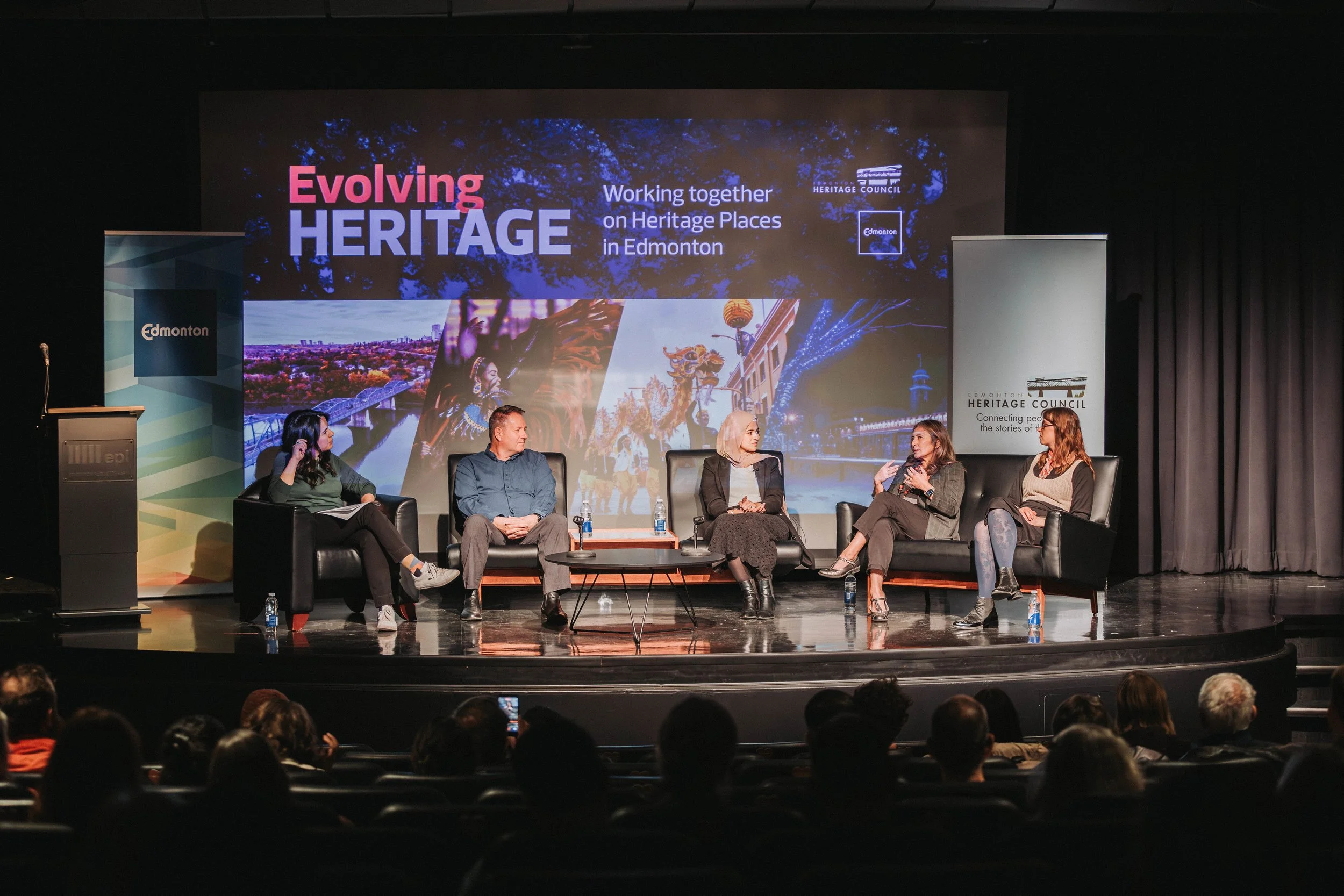
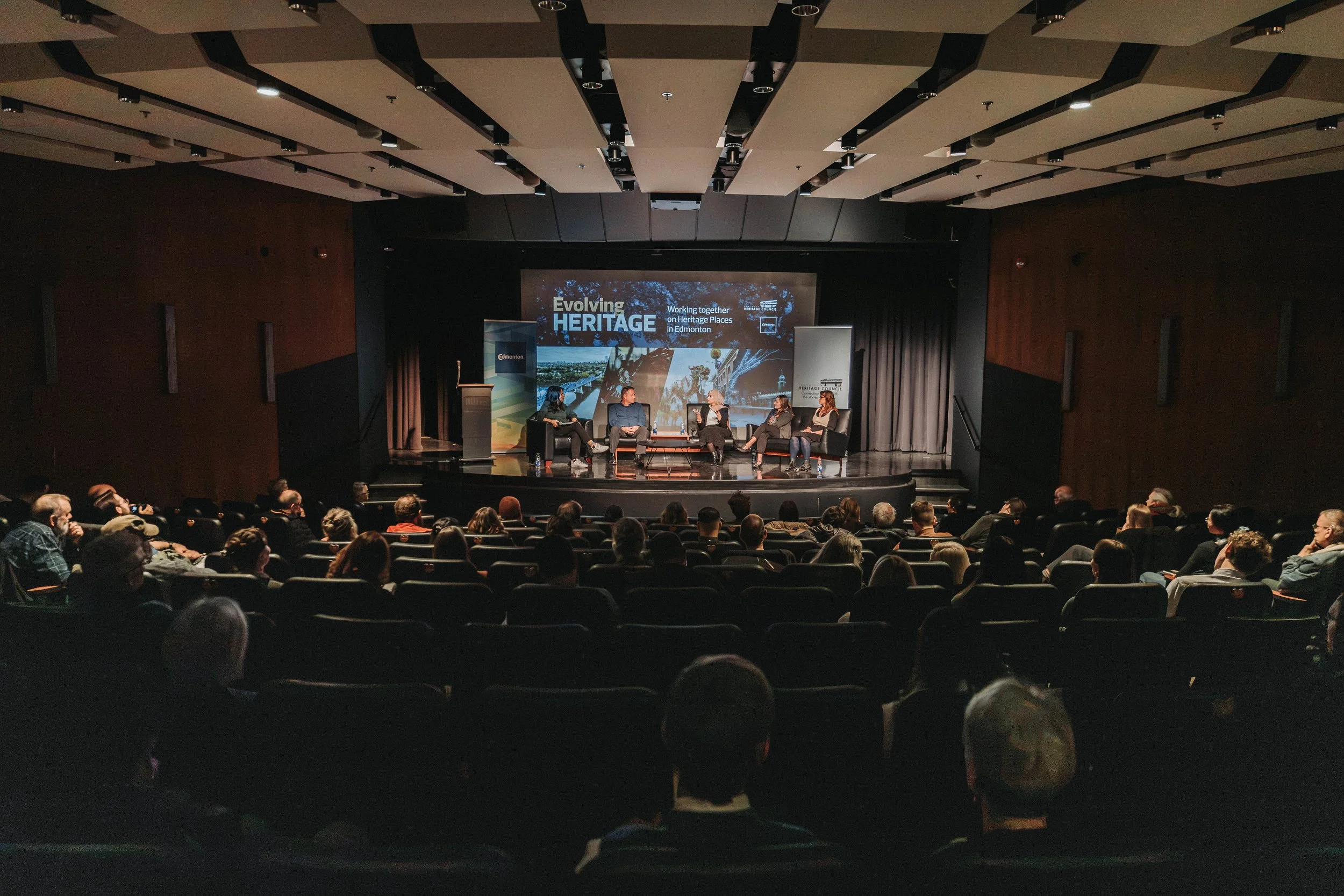
On the evening of November 3, the Stanley Milner Library’s Muttart Theatre filled for the public launch of the City of Edmonton’s new Heritage Places Strategy, co-hosted by the City and the Edmonton Heritage Council. The strategy replaces the 2009 Historic Resource Management Plan and widens the City’s heritage work to four pillars: natural heritage, Indigenous heritage, community and cultural heritage, and built heritage. Councillor Anne Stevenson set the tone in her welcome: “Our story has always been so much bigger than our buildings.”
The panel that followed was not a policy walkthrough. Moderator Jacquelyn Cardinal, a sakāwithiniwak (Woodland Cree) entrepreneur and Indigenous technologist from Sucker Creek Cree First Nation and co-founder and CEO of Naheyawin, guided it through six questions. She ran the knowledge-sharing circles with the City’s Indigenous partners for the strategy, and that experience shaped the evening. Everyone she heard from described heritage differently, and together their stories revealed “a more full, multifaceted whole.” Those stories tended to turn on a moment of connection to family and community, or a moment of disconnection and the longing to repair it. Her questions followed the same arc, from why people care, to what counts, to how stories layer, to what we owe the future, to who gets a seat, and finally to what to do next.
Why this work?
Jacquelyn started where her own interviews started: when did each panelist decide heritage was their work? The four answers were more personal than professional.
Sydney Gross, the City’s Principal Heritage Planner, admitted she could give “the lib answer of I got the job.” The truer one was in what she called her “mental photo album,” where the moments that mattered most kept happening in older places, like the music venues she loved. Becoming a planner, and then a heritage planner, tied that together.
Ida Lucila, Edmonton’s Historian Laureate and Executive Director of the Edmonton Philippine International Centre, described the loss that comes with migration, including the loss of her own artistic life and identity. Heritage was what rebuilt it. “That’s when heritage becomes your anchor,” she said, and finding places that felt like home is how “you turn the sense of loss into a sense of belonging.”
Marwa Alshara, an architect with Stantec, spoke as someone displaced from Damascus 14 years ago who returned only a few months earlier. The trip changed what the word means to her: “Heritage is something that we carry with us, and it’s not necessarily represented in one building or one place.”
Geoff Wagner, Chair of the Edmonton Heritage Council, came to it the long way. He called himself a built heritage guy, then immediately corrected himself: “It’s not actually about the things. It’s actually about the stories that are involved with these things.”
What counts as heritage?
Jacquelyn turned to Ida’s Echoes of Identity project, a digital cultural map of Filipinos in Edmonton, to ask what an expanded definition of heritage can do. Ida’s answer started with the places themselves. For immigrant communities, heritage often lives in church basements, community halls, or a storefront in an ordinary strip mall. These are places that are cultural hubs and economic hubs, and they appear in no archive.
Her method follows from that. Formal calls for submissions do not reach families working three jobs, so she goes to homes and goes through personal photo albums. The result is a shift in role, from people observing history to people who “curate their own stories.” The work is also intergenerational. Younger organizers sometimes tell her a project has never been done, and she has to tell them it has, and that the knowledge was lost between generations.
How do stories layer and change?
For Geoff, Jacquelyn chose Rossdale, a place her own family has talked about for years. How do you keep telling the older stories while leaving space for new ones?
Geoff said the answer is that he is not the author. After thousands of tours, he has learned that visitors arrive with their own connections to the site, and those connections become part of what he retells. “I’m not telling my story across the platform,” he said. “I’m telling other people’s stories.” He described a site with at least 10,000 years of Indigenous history, then Fort Edmonton, a sawmill, a racetrack, and the founding of the province. A plaque on one building, he said, does not do justice to that. When new information arrives, the work is deciding how it fits with everything else, and sometimes living with two accounts that cannot both be true. It is also why he finds the layering so compelling: “It weaves us all together, no matter where we come from or what we do.”
What do we owe the future?
Jacquelyn then raised the Indigenous teaching of seven generations and the idea of being a future ancestor. She asked Marwa how conversations go when communities decide together what to carry forward.
Marwa said everything starts with listening, and no one can say in advance whether one engagement session is enough or whether it takes two. Each session surfaces new perspectives, and when a story comes genuinely from the community, the community becomes the building’s advocate. She told of a school she designed with sweetgrass in its cladding and interiors, as a symbol of truth, trust and justice. Years later, when she returned to lead an expansion and told 150 students about it, they had no idea and went outside to look. Her lesson was that nobody should assume people know a building’s story. They survive only if they keep being told. She also warned against decoration standing in for engagement, such as an Islamic pattern dropped in as a gesture or a TV placed in a space that deserved more. And she offered a quiet challenge: if Canada is the land of Indigenous people and also of everyone who came from elsewhere, whose stories is it telling now?
Who is at the table?
The fifth question went to Sydney. Jacquelyn asked how much it matters to have more people involved, and whether getting them there keeps her up at night. Sydney called it “the most important thing, and also probably the hardest thing.” Someone had once asked how the project team would engage every Edmontonian, and her reaction was, “How does anybody do that?” Her answer was reciprocity: listening, giving, making space, and hoping people do the same.
Jacquelyn followed up by asking whether anyone dives into this work and walks away with less than they gave. Her own experience was the opposite. People leave with more than they expected, like the family who sat down for one kitchen-table interview and found they had far more stories than they knew. Sydney agreed that every encounter in her job is meaningful in some way.
Where should someone start?
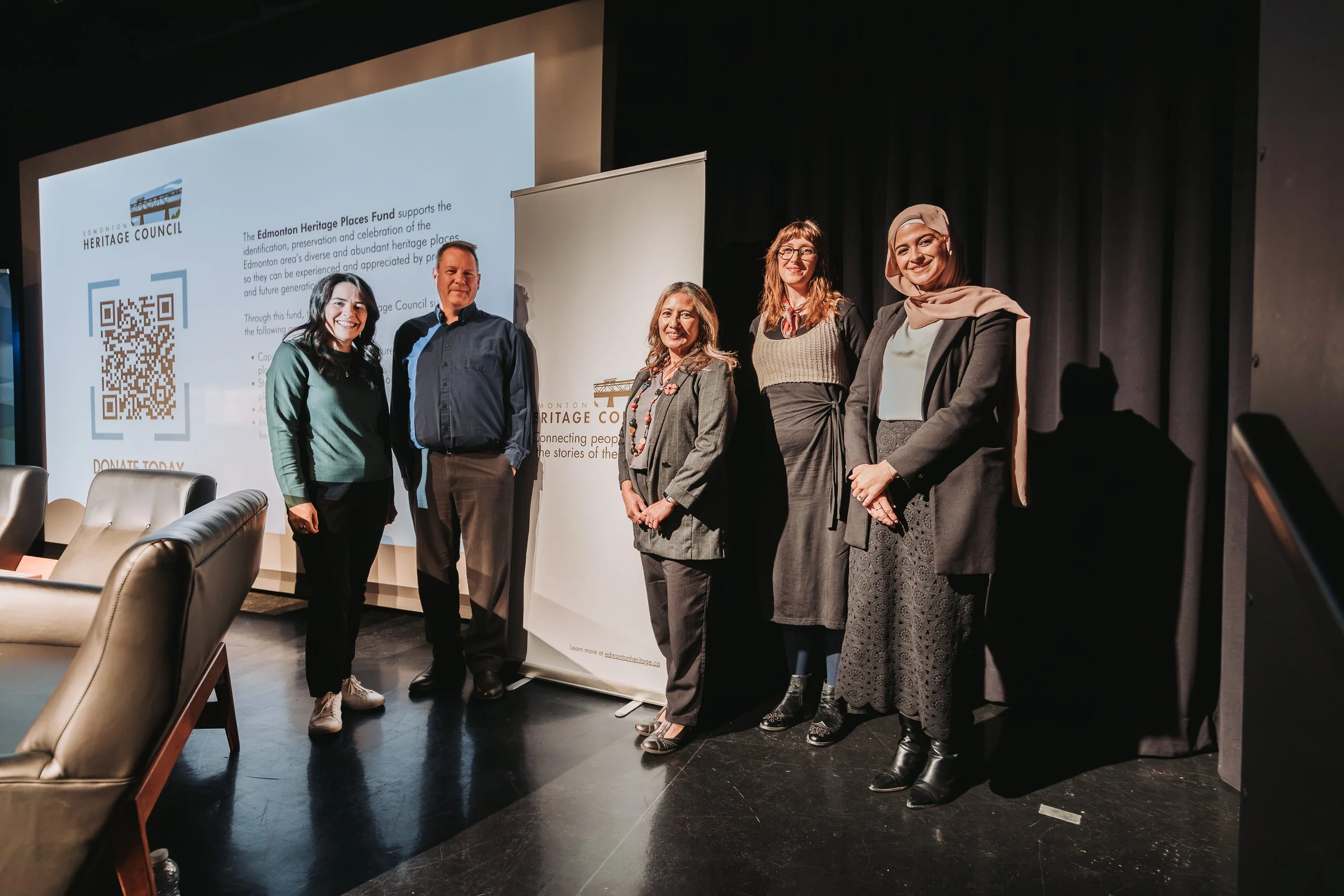
Jacquelyn closed by asking each panelist what they would say to someone fired up to get involved. Sydney recommended ECAMP, the virtual museum of Edmonton stories, and Edmonton Heritage Council events. Ida said to ask people about themselves, and to reframe the question when they say they have nothing to share. Asking what someone brought with them when they first migrated gets a story that “do you have any artifacts?” never will. Marwa pointed out that the strategy has four pillars, so almost everyone can find one that fits, and that building the city together takes everyone: kids, elders, women and men. Geoff gave the most direct answer. Share your stories, even the ones you think are ordinary, and then find a heritage organization that resonates with you and give it a little time.
The audience questions tested how far the new definition reaches. A volunteer from the Edmonton Radial Railway Society asked how century-old operating streetcars can be protected when they fall outside conventional designation, and where community stories can find a shared home. Sydney said she would need to think beyond the usual boundaries of a municipal bylaw. Geoff pointed to provincial artifact designation and acknowledged that ECAMP’s capacity to host every story is limited. A resident raised the river valley and the wetlands. Another speaker urged that the Indigenous ward names be taught in schools. A member of an Indigenous band asked pointedly about Rossdale and whether the strategy would finally protect it, and Jacquelyn directed him to continue the conversation with City Council.
Our Executive Director, David Ridley ended the evening by treating the gathering itself as the point. “The strategy itself is engagement,” he said, and called it “a generational plan.” He tied the stories heard that night to the City’s 2027 to 2030 budget, noting that they “depend on sustained public investment.” He asked attendees to register to speak at public hearings and write to their councillors, and to consider giving to the Edmonton Heritage Places Endowment Fund at the Edmonton Community Foundation, where donations are matched.
Jacquelyn had the last word on the panel. As with all of this work, she said, she was walking away “with much more than I gave.”